Can AI Build Your Next Checkout?
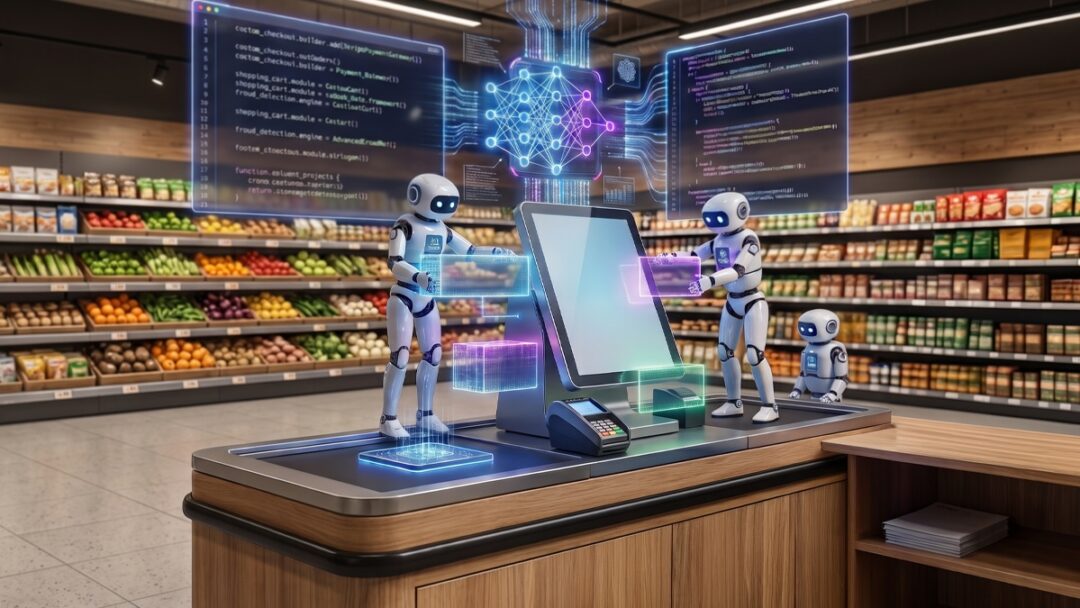
AI has made it possible to build software faster than ever before.
A capable team can now turn an idea into a working prototype in days. AI can generate code, create interfaces, write tests and help developers work with unfamiliar technologies.
This has prompted an understandable question in retail: if AI makes software so much easier to create, why continue buying products from independent software vendors? Why shouldn’t a retailer use AI to build its own checkout and related store systems?
It is a fair question. But it rests on a misunderstanding of what a software product really is.
AI has significantly reduced the effort required to produce code. It has not removed the complexity or responsibility of delivering checkout as a continuously operated, mission-critical service. Nowhere is that distinction clearer than at checkout.
Building the demo is the easy part
A checkout demonstration can be created surprisingly quickly.
Scan an item. Look up its price. Apply a promotion. Take a payment. Produce a receipt. Presented in a controlled environment, the result can look convincing.
But a checkout demo is not a checkout product.
A real checkout must operate across different stores, markets and trading conditions. It must connect reliably with payment systems, loyalty, promotions, enterprise data, fiscal services and store hardware.
It must also handle exceptions as reliably as the standard journey. Networks fail, product data is incomplete, promotions conflict and payment outcomes are not always clear. These are not unusual edge cases; they are part of everyday retail.
The difference between a demonstration and a product is not the quality of its happiest path. It is the product’s ability to keep trading through thousands of imperfect situations.
Code is only one part of the product
A SaaS provider does not simply deliver code. It operates and continuously evolves a service on which retailers depend every trading day.
A production retail platform contains accumulated decisions about security, performance, integration, resilience and support. It reflects knowledge gained from operating across different customers and environments, not only from what worked but also from what failed.
Much of this knowledge is almost invisible when the platform is working well. Retailers simply see that their stores continue to trade.
AI can help engineers create components more efficiently, identify defects and accelerate integration. We are already seeing substantial benefits from these capabilities.
But generating the components is not the same as assembling, validating, operating and continuously improving the complete service.
The real asset is not a body of source code. It is a continuously operated platform, together with the people, knowledge and accountability required to sustain it.
Mission-critical software requires ownership
Checkout occupies a distinctive position in the retail technology landscape. When many enterprise systems fail, work can be delayed or redirected. When checkout fails, revenue loss is immediate and potentially severe, particularly in high-volume retail, where every minute of downtime matters.
That changes the standard by which the service must be judged.
A system that works most of the time may be adequate for an internal experiment. It is not adequate for the final step of a customer’s shopping journey. The platform must perform during peak periods, under degraded conditions and while the systems around it are changing.
This requires more than engineering capacity. It requires clear ownership throughout the life of the service, from its day-to-day operation and support to its security, compatibility and continued evolution.
AI can support each of these responsibilities. It cannot be accountable for the outcome.
When trading is affected, a retailer needs a provider already responsible for operating and restoring the service, not simply a team with access to its code.
The maintenance obligation begins on launch day
AI can make the initial build appear inexpensive. That can distort the build-versus-buy calculation.
The largest cost of a mission-critical product is rarely its first version. The greater commitment comes after launch.
Integrations and dependencies must be maintained. Regulations change. Technology platforms evolve. New payment methods, customer propositions and store formats create additional requirements.
Meanwhile, the retailer must retain the people and knowledge needed to understand the system. Teams change, original decisions become harder to reconstruct and short-term solutions accumulate. What began as a contained development project becomes a permanent operational responsibility.
This is one of the fundamental advantages of SaaS. Much of that ongoing obligation sits with the provider. The platform is continuously maintained and improved, while each retailer benefits from investment and learning across the wider service.
This does not mean retailers should never build software themselves. They should invest deeply in capabilities that genuinely differentiate their businesses.
But recreating mature infrastructure has an opportunity cost. Engineering talent committed to rebuilding and maintaining checkout foundations cannot simultaneously focus on the experiences, insights and operating models that make the retailer distinctive.
The important question is therefore not simply, “Can we build this?”
With AI, the answer will increasingly be yes.
The better question is, “Do we also want to operate, maintain and evolve it indefinitely?”
AI does not belong only to retailers
The argument that AI will eliminate software vendors sometimes assumes that retailers gain access to AI while vendors continue working as they did before.
That is not what is happening.
At Extenda Retail, we are already using AI across our software development lifecycle to help us build, test, deliver and support our products more effectively. At the same time, we are bringing AI into our products to create new value for retailers and make those products easier to use and extend.
The benefit is not simply that we can perform the same work faster. As a focused retail SaaS provider, we can apply what we learn across multiple customers, markets and operating environments. That knowledge becomes part of the platform and benefits every retailer that depends on it.
This creates a compounding advantage.
Because Hii Retail is delivered as SaaS, an issue discovered in one environment can lead to improvements across the service. A regulatory change can be addressed within the platform rather than solved independently by every retailer. Experience across different store estates can inform more resilient product decisions.
AI makes this learning cycle faster. It does not make shared expertise less valuable.
The ISVs that thrive will not be those that defend slow delivery or rigid products. AI rightly raises expectations. Vendors must move faster, reduce implementation effort and give retailers greater control over how products adapt to their businesses.
The role of the ISV is evolving, but it is not disappearing.
From software supplier to product partner
The traditional boundary between building and buying is becoming less rigid.
Retailers will increasingly use AI to create extensions, automate workflows and explore new customer journeys. They will expect platforms to be open and adaptable rather than closed and prescriptive.
This is where architecture matters. Long before the current excitement around agentic AI, Hii Retail was built around MACH principles and an API-first approach. Those choices now give retailers and their AI coding agents a straightforward path to build differentiating capabilities through supported APIs, without having to fork, modify or assume responsibility for the mission-critical core.
This is a positive development.
The best outcome is neither a retailer surrendering all innovation to a vendor nor rebuilding every foundational capability alone. It is a model in which the provider operates a dependable SaaS platform while the retailer retains the freedom to differentiate around it.
For an ISV, that means delivering more than features. It means providing a stable foundation, domain expertise, a clear evolution path and accountability for the platform in operation. It also means giving retailers room to apply their own data, intelligence and creativity without compromising the integrity of the core service.
At Extenda Retail, we see AI as an accelerator of this model. It gives us new ways to develop and operate Hii Retail as a SaaS platform, while creating new opportunities for customers to build differentiated experiences around it.
The value lies in combining this new speed with the retail knowledge and operational responsibility that mission-critical software demands.
The question AI does not remove
AI is changing software development profoundly. It will make more ideas viable, allow smaller teams to achieve more and challenge every software company to deliver greater value.
But easier code generation does not turn every organisation into a product company, and it does not turn a prototype into a production platform.
Checkout is not simply a collection of screens and services. It is a long-term commitment to keep retailers trading through constant change, unpredictable conditions and millions of customer interactions.
AI changes how that commitment is fulfilled. It does not make the commitment disappear.
A checkout demo can now be built faster than ever.
A checkout product still has to earn its place in every transaction, every store and every day.