
It’s hard to admit a relationship isn’t working.
The fear of change keeps many retailers committed to disconnected systems, workarounds and operational stress long after the warning signs appear.

Do any of these checkout anxieties sound familiar?

🚩 Things looked better in the demo.
🚩 Retail processes feel held together by workarounds.
🚩 Peak trading comes with unnecessary stress.
🚩 Teams no longer fully trust the POS system.
🚩 Operational chaos is accepted as “normal.”
We’ve got news for you: these are POS relationship red flags.
"How to spot red flags in your POS relationship"
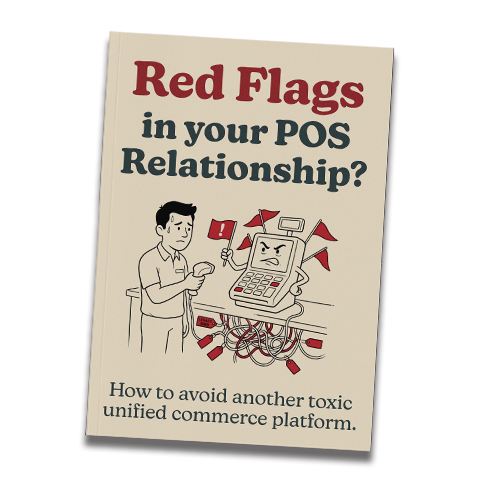
Get your copy
A practical (and slightly therapeutic) guide for retailers who want to separate genuine unified commerce solutions from misleading sales pitches.
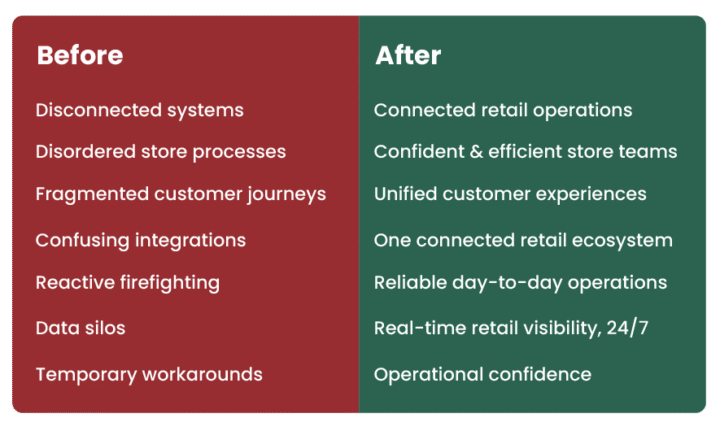
From fragmented relationships… to healthier retailing.
Our counselor has seen remarkable results when retailers stop settling, set clearer expectations, and put their own needs first.
Anonymous retail confessions
Hear from retailers who’ve left unhealthy POS relationships*.
We realised our ‘unified’ platform was actually five disconnected systems.
“Every customer issue became an operational issue. Inventory was inconsistent, reporting never matched, and store teams stopped trusting the system entirely. We knew something had to change.”
Head of Retail Operations, Fashion Brand
**Retailer identities have been protected to avoid awkward
vendor conversations

Peak trading became genuinely stressful.
“We spent every Black Friday preparing for outages instead of customers. The final straw was realizing our staff had better workaround processes than the platform itself.”
eCommerce Director, Homeware Retailer
**Retailer identities have been protected to avoid awkward
vendor conversations

The demos looked seamless. The reality was chaos.
“We bought into the unified commerce messaging, but ended up managing integrations, synchronization issues and endless development conversations. It became exhausting.”
Retail Technology Lead, Grocery Retailer
**Retailer identities have been protected to avoid awkward
vendor conversations

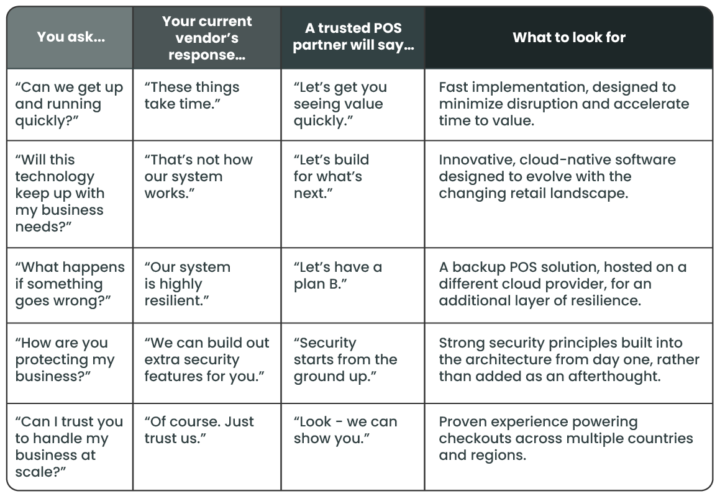
POS relationship health check
Use the scenarios below to spot the difference between settling and getting the POS partnership you deserve.
Dr. POSsible’s professional opinion
Your checkout relationship questions, answered.
Why do fragmented POS relationships happen?
Many retail platforms were never originally designed as unified systems. Over time, integrations, middleware and disconnected services can create operational complexity beneath the surface.
My vendor says they'll improve after the next update. Should I wait?
If operational issues have become normalized (such as inconsistent inventory, manual workarounds, stressed staff) another patch or integration layer probably isn't going to solve the root problem.
How do I know if we've outgrown our current setup?
If your teams spend more time managing the system than benefiting from it, that's usually a strong sign your retail architecture is holding you back.
What does healthy unified commerce actually look like?
Connected data. Consistent customer experiences. Real-time visibility. Operational resilience. And store teams that trust the system they're using every day. For example, Hii Retail is a comprehensive unified commerce platform built on Google Cloud.
Is it disloyal to look at other POS vendors if I'm already in a contract?
Not at all. Unlike normal relationships, retail technology benefits from comparison. Arranging demos with other vendors helps you understand how you could be handling integrations, customer data and store operations.
You deserve a healthier POS relationship.
If your current checkout operations feel stressful, disconnected or harder to defend… it might be time to take action.
Download the self-help guide to learn:
✓ The warning signs of fragmented commerce
✓ What genuine unified retail should feel like
✓ How to evaluate POS vendors with confidence