
UNIFIED COMMERCE
Unified commerce: No siloed channels. Just one experience.
From customer experience to inventory and beyond, unified commerce solves fragmentation for retailers - and we’re setting the standard.
What is Unified Commerce?
When systems don’t talk to each other, your customers can feel it. Unreliable stock data, inconsistent experiences, missed sales - it all adds up. Unified commerce is the strategy that connects every system and channel, so your business runs smarter and shoppers enjoy a seamless experience, every time.
Unified commerce benefits for shoppers:
- Accurate stock — they never see unavailable products
- Unified offers — same price & promotion on every channel
- Seamless payments — unbeatable checkout experiences
- Connected channels — shop how they want, across every touchpoint
- Trust and loyalty — reliable experiences make you their first choice


For your business, this means:
- A single technology landscape — fewer vendors, fewer moving parts.
- Lower operational complexity — teams spend time serving customers, not firefighting.
- Better visibility and analytics — real data, real-time, from one source of truth.
- Faster innovation and rollout — launch new experiences without re-platforming.
- A scalable retail foundation — grow without replacing your core systems.
How Extenda Retail Enables Unified Commerce
Our Hii Retail platform is built to connect your entire retail experience — from store to mobile to digital — using a modern, API-first, cloud-native architecture.
One engine for retail operations
Hii Retail unifies POS, Checkout, Inventory, Pricing and Promotions on one platform — with real-time updates across every channel.
Real-time data everywhere
Your stock, pricing and transactions stay perfectly in sync — giving customers accuracy and your teams clarity.
Flexible checkout for every journey
Traditional POS, mPOS, Self-Checkout, Scan & Go and consumer apps — powered by the same logic, same data, same experience.
Cloud-native stability & scalability
Enterprise security, automatic scaling and continuous updates via Google Cloud ensure your business is always ready for tomorrow.
API-first for fast innovation
Integrate faster, launch new formats, expand into new markets — without re-platforming or technical debt.
Unified e-commerce
Online shopping powered by the same engine as your stores — real-time stock, shared prices and a unified basket everywhere.

“The lookup of customer information, giftcarding - there’s a lot of integrations going on behind the scenes. With Hii Retail, we can manage all the different campaign variations and it works like clockwork.”
- Olav Fyldeng, Chief Information Officer, Plantagen
Level up your retail operations – from omnichannel to unified commerce

Curious to hear how retailers such as Apple, Walmart, Uniqlo and Coop are delivering truly unified shopping experiences? Overwhelmed by the array of tech solutions all claiming to enable unified commerce?
Our retail experts have written this handbook just for you. This bitesize PDF offers actionable insights to help you prepare for the future of retail. Download today to:
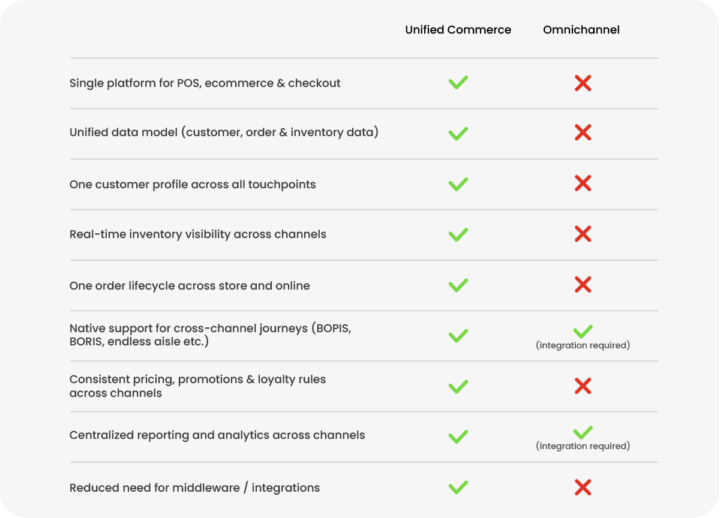
Unified commerce vs. omnichannel
Learn more from our resource center

Extenda Retail Appoints Henrik Nilsson as Chief Revenue Officer

Extenda Retail announces new CEO and CFO appointments

How to Choose a Cost-Effective POS System for Your Retail Business
Frequently Asked Questions
What is unified commerce?
Unified commerce is a business approach that connects all customer touchpoints—online, in-store, mobile, customer service, and fulfillment—on a single platform. Unlike traditional omnichannel setups, unified commerce uses one shared data model, so inventory, orders, customers, and payments are always in sync in real time.
How is unified commerce different from omnichannel?
Omnichannel typically connects separate systems through integrations, which can lead to delays and data inconsistencies. Unified commerce runs on a single, centralized platform, eliminating data silos and enabling real-time visibility across all channels.
What problems does unified commerce solve?
Unified commerce helps businesses:
- Eliminate inventory inaccuracies
- Reduce order fulfillment errors
- Create seamless customer experiences across channels
- Simplify operations and reporting
- Scale faster without adding system complexity
Is unified commerce difficult to implement?
Implementation depends on your current systems and business complexity, but unified commerce typically reduces long-term complexity by replacing multiple disconnected systems with one unified platform.
Can unified commerce scale as my business grows?
Absolutely. Unified commerce is built to scale with new sales channels, locations, and markets without requiring additional systems or complex integrations.
Who is unified commerce for?
Unified commerce is ideal for retailers and brands that sell across multiple channels — online, in-store, marketplaces, and social commerce — and want a consistent customer experience with simpler operations behind the scenes.
Can unified commerce support both online and in-store sales?
Yes. Unified commerce is designed to support online, in-store, mobile, and assisted sales from a single platform, allowing customers to browse, buy, return, or exchange anywhere.
How does unified commerce improve the customer experience?
By using a single source of truth for customer and order data, unified commerce enables:
- Buy online, pick up in store (BOPIS)
- Ship from store
- Easy returns and exchanges across channels
- Personalized experiences based on real customer history
.
How does unified commerce impact reporting and analytics?
Because all data lives in one platform, reporting is faster, more accurate, and more actionable — giving teams a complete view of sales, inventory, customers, and performance in real time.
.
It’s time to unlock unified experiences.
Our experts are ready to show you unified commerce in action. Request a demo to experience fast and friction-free selling.